
Small Kitchen Drawer Organizers: Measure Before Buying
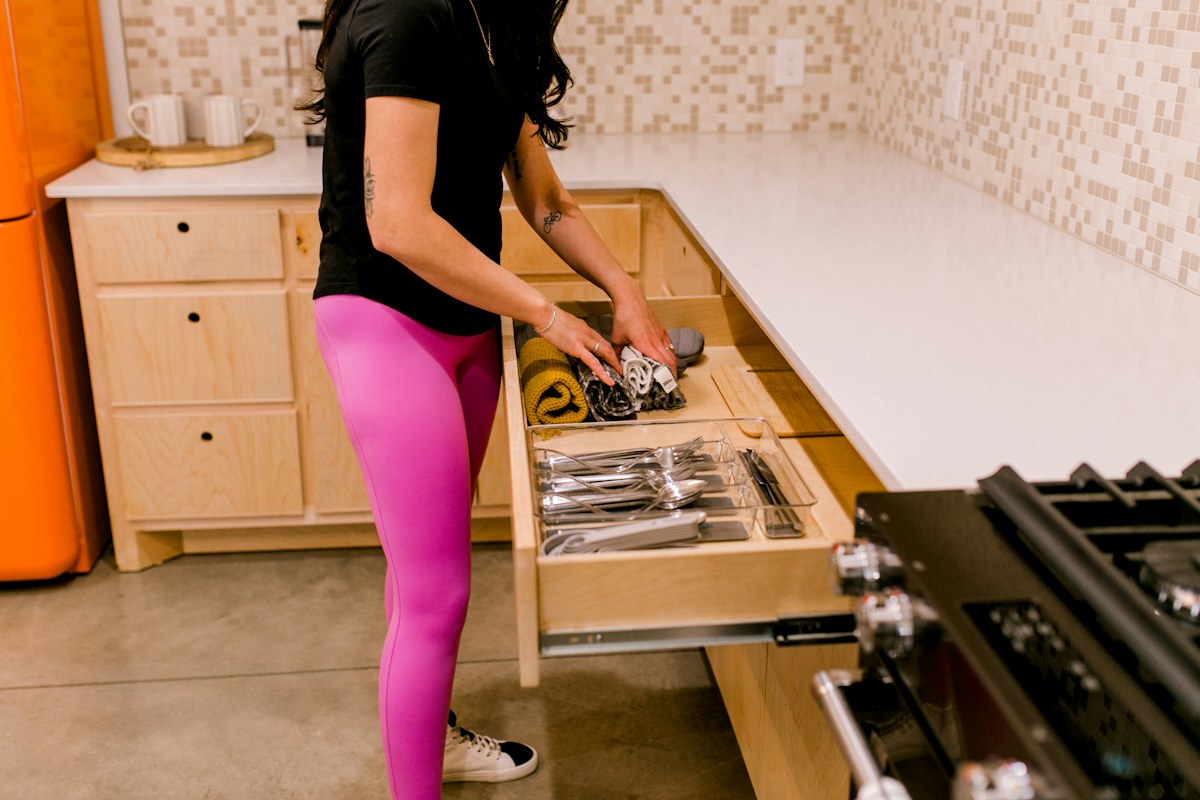
Measure the drawer interior and longest daily tools, sketch the combined compartment layout, then choose individual trays, a fixed insert or compatible dividers.
This page contains affiliate links. As an Amazon Associate I earn from qualifying purchases.
Empty the drawer and sort by task
Identify long, wide or unusually shaped tools first. A whisk or serving spoon may determine the minimum compartment length. Small packets and clips can share a shallow bin, but avoid making a bin so deep that it hides its own contents. Arrange the frequently used items in one layer on the counter. If they cannot fit within the approximate drawer footprint without stacking, the problem is capacity or category selection rather than the lack of dividers.
Measure the inside box, not the cabinet front
Open the drawer fully. Measure its internal width at the bottom and near the top, internal front-to-back depth, and usable height beneath any counter overhang. Drawer boxes can taper, and runners or screws can intrude. Measure the clear opening when the drawer is extended; an organizer may fit inside but be impossible to place through a narrow opening. Leave a little tolerance instead of buying a tray with exactly the same listed width.
Check whether the drawer opens completely. A partially extending drawer can hide the back compartment under the counter. If a tray has a lip or expandable wings, compare its widest assembled dimension with the box. If it has a raised handle or tall divider, make sure the drawer closes with your tallest utensil in place. Trace the interior on paper and draw the long utensils at scale; this quickly shows whether a standard cutlery tray's slots are a useful shape.
Calculate a tray layout before ordering the pack
Imagine a drawer whose internal base is 40 by 35 centimetres. Three proposed trays occupy widths of 10, 12 and 15 centimetres side by side. Their total width is 37 centimetres, leaving three centimetres in that direction before allowances for tapered walls or movement. Their individual lengths must still fit the 35-centimetre depth. These are illustrative dimensions, not specifications for the linked Vtopmart set.
Place the longest tool in the sketch next. If it is 32 centimetres long but the selected compartment is only 28 centimetres inside, the outer tray fit is irrelevant to that tool. Allocate a longer compartment, move the tool to another suitable zone or choose a different organizer format. Do not assume diagonal placement works without checking the tool height and safe retrieval.
Finish by comparing the documented size mix in the selected pack with the few pieces required by the sketch. Unused trays can remain unused. A larger pack should not turn a straightforward cutlery layout into a row of compartments too small for the belongings you actually return after washing.
Draw the arrangement before buying a tray set
For this hypothetical drawer, everyday spoons and forks are mixed with a long spatula, a peeler and several rarely used tools. Remove the occasional tools first. Measure the drawer interior at the narrowest point, including any curved sides or hardware, then measure the longest item you intend to return.
| Approach | Useful when | Check | Drawback |
|---|---|---|---|
| Individual trays | Several small categories need separate compartments | The combined layout, not just one tray's dimensions | Gaps or too many tiny compartments can waste space |
| One fixed insert | A stable cutlery layout matches the drawer | Outer dimensions and internal compartment length | Long or unusual tools may not fit |
| Adjustable dividers | Category widths vary | Expansion range, attachment method and drawer compatibility | The divider system can use space itself |
| No added organizer | A small edited set already stays separated | Whether items remain easy to find and safe to retrieve | A mixed pile may return if the inventory grows |
A layout rehearsal using paper
Mark the drawer outline and the dimensions of any proposed trays on paper. Place the longest utensil in the plan first, then allocate smaller daily categories. Check height as well as length: a tool handle can project above a tray and catch as the drawer closes. Keep sharp items in storage designed for safe retrieval rather than treating an open tray as a universal tool holder.
If the drawer remains crowded after removing occasional tools, put suitable utensils in an appropriate existing cooking zone described in the cabinet guide. Avoid moving the entire pile onto the counter; the counter workflow plan explains what needs that space. A successful drawer arrangement lets you return each daily item without rearranging the other compartments.
Maintain the paper layout until after the first normal wash-and-put-away cycle. A compartment that fits one dry utensil can be inconvenient when several items need returning at once. Note any handle that catches, category that overflows or tray that shifts under ordinary use. Follow the organizer’s compatibility instructions rather than adding improvised attachments. Change the compartment plan before spending on another piece additional pieces from the same set.
Revisit the drawer after the first big grocery trip or weekend cooking session. If tools still collect beside the stove, move the most used group closer to that task. If a compartment stays empty, give its width to a crowded neighboring group where the organizer permits it.
Choose the layout for the contents
Fixed trays are simple when the compartments match a consistent set of cutlery. Adjustable dividers help when the drawer contains tools of different lengths and widths. Small modular bins can create a custom layout but may slide unless the base or drawer keeps them stable. Avoid adding so many compartments that each holds one tool with no room to grasp it. The point is to make the relevant item visible and accessible, not to reproduce a item listing photograph.
Try a no-purchase prototype with folded cardboard or temporary boxes. Give the longest tool a clear lane and group small utensils by use. Open and close the drawer several times. Does anything catch on the top? Can you take out a spatula without lifting a second item? Can every compartment be wiped? These tests reveal whether you need adjustable divisions or simply fewer items in the drawer.
Consider cleaning and materials
A kitchen drawer collects crumbs and occasional moisture. Select a tray you can remove and clean according to its material's care instructions. A very tight fit makes removal difficult. Natural materials can require different cleaning and drying care than plastic or metal. review the exact product's instructions rather than assuming any tray is dishwasher-safe or water-resistant. A thin nonslip liner can reduce movement if compatible with the drawer and organizer, but clean beneath it periodically.
Watch for sharp edges and loose adjustable parts. A divider that shifts every time you open the drawer can make the layout worse. An expandable tray may apply the drawer efficiently but add a narrow side compartment that is hard to reach. Measure the useful interior of each compartment, not just the tray's exterior. If you store food-contact utensils there, keep the organizer clean and let washed tools dry before putting them away.
Where this fits in a small kitchen
Leave the prep drawer near the place where you prepare food if possible. Items used at the stove may belong in a separate drawer or safe nearby holder. If the only drawer is very small, assign it to the tools that would otherwise clutter the counter; move occasional utensils to another cabinet. Our small kitchen storage guide helps choose what deserves counter space. The cabinet zoning guide covers the larger layout.
A utensil tray cannot solve a drawer that contains mail, batteries and food clips along with cutlery. Give unrelated categories another home before investing in a fitted organizer. If a drawer is deep, consider whether one shallow top layer is enough; stacking trays may hide the bottom and make daily use slow. An organizer should reduce the number of movements needed to retrieve something.
Before you buy
- Measure width, depth, usable height and clear opening inside the drawer.
- Identify the longest tool and group contents by task.
- Leave clearance to grasp tools and remove the tray for cleaning.
- Check the actual product's assembled and compartment dimensions.
- Test the proposed layout with temporary dividers for a week.
A well-chosen drawer organizer makes the drawer quieter and faster to use. The measurements and the categories come first; the tray is only the final fit.
Finish the arrangement for Small Kitchen Drawer Organizers
Choose the compartment arrangement that fits the daily tools and closes smoothly. Return washed items through that arrangement once before deciding whether any additional organizer is necessary.
Product candidates for Small Kitchen Drawer Organizers

xympo Coffee Mug Hanger for Cabinet, Clip-On Shelf, for Cups, Utensil, Tumbler Lid, Screwless Install (Pack of 2), Fits Shelves up to 3/4"
Chosen for Small Kitchen Drawer Organizers: it separates categories by level so a single reach does not disturb the rest. Check the counter or cabinet opening and the clearances the listing states.
VIEW AT AMAZON.COM
Expandable Bamboo Kitchen Drawer Organizer for Cutlery and Utensils, Adjustable Bamboo Wood Cutlery Tray in Drawer for Flatware and Silverware in Kitc
Matched to Small Kitchen Drawer Organizers: it adjusts to the width you actually measured instead of the width the room implies. Confirm the internal height against the tallest item it has to hold.
VIEW AT AMAZON.COM
Hedume 4 Pack Plastic Storage Bins with Handle, BPA-Free Kitchen Pantry Cabinet Refrigerator Food Storage Organizer for Snacks, Food, Produce, Pasta
Shortlisted for Small Kitchen Drawer Organizers: it closes the contents away, which suits a room that has to look calm. Verify the depth against the walkway that has to stay clear.
VIEW AT AMAZON.COMKeep exploring
 Small Kitchen
Expandable Kitchen Drawer Organizers: Check the Useful Adjustment Range
Measure the drawer interior and longest daily tools, sketch the combined compartment layout, then choose individual trays, a fixed insert or compatible dividers.
SPACEKINDLY Small Kitchen
Small Kitchen Islands: Measure the Working Routes Before Buying
Measure the drawer interior and longest daily tools, sketch the combined compartment layout, then choose individual trays, a fixed insert or compatible dividers.
SPACEKINDLY Small Kitchen
Spice Drawer Organizers: Check Jar Height and Label Visibility
A practical guide to spice drawer organizer, built around real measurements, access and the routine that has to work every day.
SPACEKINDLY