
Small Pantry Organization for Shelves, Bins and Door Space
Organize a small pantry so you can see stock, retrieve a category and return new groceries without unloading the shelf.
This page contains affiliate links. As an Amazon Associate I earn from qualifying purchases.
Empty one shelf at a time
Check dates and packaging condition while you sort. Group breakfast food, baking ingredients, canned goods, snacks, staples and meal components in ways that match your household. Put items that need using soon in a visible front position. Follow package storage instructions; not every product belongs in the pantry after opening. If you find repeated purchases of something already hidden at the back, visibility is the problem to solve first.
Measure the shelf, including access
Record internal width, depth and the vertical distance to the shelf above. Include any lip, hinge or door frame that narrows the opening. A product described as a 12-inch bin may measure that width at its rim while the base is narrower; compare its exterior dimensions with the pantry opening. Allow space above the bin to lift it out. A clear box can make contents visible, but only if you can see through its useful side in your layout.
Measure the pantry door in both open and closed positions. Door-mounted storage projects inward and can collide with shelves, bottles or handles. check the door construction and mounting instructions before putting heavy jars on it. A slim door pocket can hold lightweight spices or packets if it closes freely; it should not carry every heavy can because the hinge happened to look strong. Mark the proposed depth with cardboard and test the door swing.
Build a pantry you can shop from
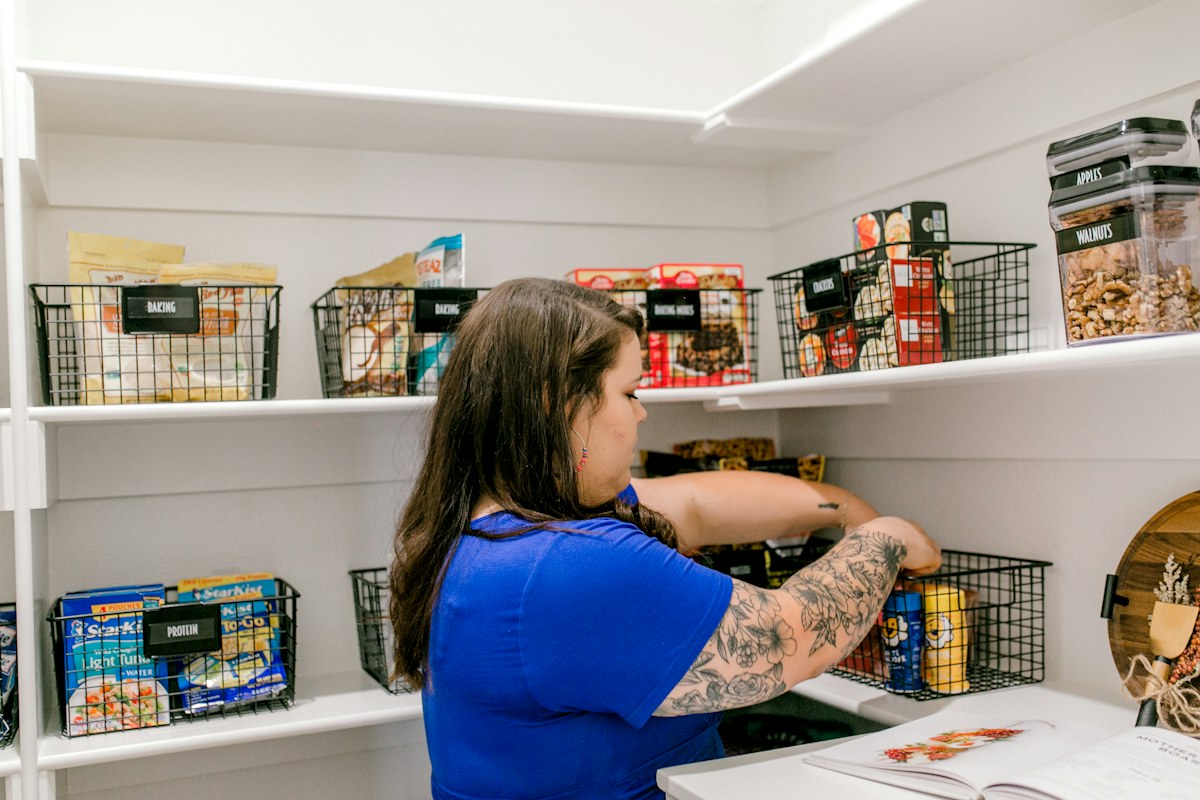
In a hypothetical pantry with deep shelves, breakfast foods occupy the front and forgotten baking ingredients sit behind them. Start by checking packaging and dates, discarding items as appropriate, and grouping the ingredients you actually use together. A container earns its space when you can remove that group without unpacking unrelated food.
| Situation | Possible change | Limit to check |
|---|---|---|
| Small packets disappear behind jars | A shallow removable bin for that category | Packets remain visible and the bin can pass the shelf lip |
| Two unrelated rows block one another | Separate active and occasional categories | The back group can be retrieved without a full shelf unload |
| The door looks unused | A compatible door rack for suitable items | Hook fit, loaded depth, hinges and nearby shelves |
| Food piles above a label | Reduce or divide the category | The container is not oversized for the actual shelf |
Make the next shopping trip part of the arrangement
Put newly bought items behind the older usable stock within the same category where practical. Keep dates and required storage instructions available; matching containers should not erase the information needed to store or prepare food safely. put on paper what is genuinely missing before purchasing another pack. A clear bin can show stock, but a crowded transparent box still hides what is behind it.
Choose bins before adding a door rack
Try the existing shelves first. A rack may help with small suitable packages, yet can collide with stored food when the door closes. Mark its loaded projection rather than only the empty frame depth. Do not overload the door or assume every hinge and hook arrangement can support the advertised configuration.
ClearSpace and SKTEET bins represent removable grouping options; Moforoco represents a door-storage option. Their exact internal sizes, package mix and mounting requirements need checking in the chosen listing. If the pantry is also holding cookware, reorganize that category through the kitchen cabinet plan. Keeping cookware out of the food-stock view makes the pantry easier to inventory.
Create a shelf label for the category, not a promise to fill that area. A baking bin may be partly empty for months and still be useful if it makes the actual ingredients easy to find. Check that labels remain meaningful when shopping habits change. If unused duplicates occupy the best retrieval position, move or reduce that stock as appropriate before introducing another storage rack. The benefit should appear on the next shopping list: fewer forgotten packets and a clearer view of what needs replenishing.
If your pantry has adjustable shelves, change their heights after grouping the food rather than before. Give tall bottles one section and keep shorter cans in a lower-clearance section. Leave enough headroom to grasp the item, especially on a top shelf. A shelf that is packed to the one remaining inch may look efficient but slow down every retrieval. Photograph the arrangement after a week so you can see whether the food that comes back from shopping still has a clear home.
Put food where it is used
Place frequent items around eye to waist height. Put heavy cans low to reduce awkward lifting, and reserve high shelves for light, less-used supplies. If children choose their own snacks, give them a reachable category that does not require moving a heavy container. Put ingredients for a common meal near each other when that makes cooking faster. A perfectly sorted pantry that requires several moves to retrieve pasta and sauce will not stay orderly.
Choose one spot for food approaching its best-by date and check it before shopping. Date labels are about quality and safety in different ways depending on the food; follow package guidance and appropriate food safety advice. Do not pour everything into unlabeled containers and lose cooking directions, allergen information or dates. If you decant dry goods, preserve the original information or label the container clearly, and clean it between refills.
Open shelves and bins have different strengths
Open shelves make jars and cans immediately visible. A riser may expose a second row, but it requires enough vertical space and a stable base. Bins are better for packets and bags that slump or scatter. Transparent sides can help you notice stock levels; handles help if the shelf is deep. Choose a shallow bin if it needs to come out frequently, and confirm its loaded weight is comfortable to lift. A bin of canned food can become surprisingly heavy.
Do not buy a complete matching set before grouping your food. Your pantry may need only two bins and one shelf adjustment. Uniform containers look calm but can waste space if their dimensions do not match the shelf or the products. Test one category for a week. If people keep taking the whole bin out and leaving it on the counter, move it closer or make its contents easier to see.
Use door storage selectively
Door space suits narrow, lightweight items that would otherwise disappear on a deep shelf. review the clearance to the fixed shelves and maintain the door's weight and movement in mind. An over-door rack may prevent a tight door from closing; a screw-mounted option needs a suitable substrate and correct installation. If the door opens against a wall, review the new hardware will not strike it. Do not place glass containers where door movement could shake them loose.
Door shelves can also hold household items, but keep cleaners separate from food and follow product storage directions. A pantry door is not automatically a safe location for chemicals, especially with children. If the door is flimsy, leave it bare and improve shelf access instead. Empty door space can be useful if it makes the pantry easy to open and inspect.
Make shopping and restocking simpler
Keep similar foods together so you can see what you own before shopping. Put newly purchased items behind older compatible stock when appropriate, while still checking dates. Avoid buying a large bulk package merely because a bin looks half-empty. The pantry should reflect your actual cooking, not an idealized inventory. If a category grows beyond its assigned shelf, decide whether to reduce backstock or give it a larger zone before adding another container.
For a kitchen-wide plan, see cabinet zones and shelf height. It helps decide which ingredients belong near the stove and which can stay in the pantry. Our small kitchen storage guide also covers how to keep food overflow from occupying the preparation counter. The pantry works best as part of that larger routine.
Pantry fit checklist
- Measure interior shelf dimensions and the opening you actually reach through.
- Check door clearance before hanging a rack.
- Put heavy food low and frequent items at comfortable reach.
- Keep dates and package information visible or recorded.
- Buy containers for categories that need them, not for the entire pantry at once.
Finish the arrangement for Small Pantry Organization for Shelves, Bins and Door Space
Judge the pantry by retrieval and stock visibility. If you can find ingredients, put groceries away and write an accurate shopping list, the arrangement is doing its job.
Product candidates for Small Pantry Organization for Shelves, Bins and Door Space

43"H Pantry Cabinet with 4 Doors, Kitchen Cabinet with 6 Door Shelves
Chosen for Small Pantry Organization for Shelves, Bins and Door Space: it separates categories by level so a single reach does not disturb the rest. Check the counter or cabinet opening and the clearances the listing states.
VIEW AT AMAZON.COM
288 Pantry Labels for Food Containers, Black Preprinted Minimalist Waterproof Stickers for Organizing Storage Bins, Jars and Kitchen
Matched to Small Pantry Organization for Shelves, Bins and Door Space: it labels what is inside, which is what keeps a system working after the first week. Confirm the internal height against the tallest item it has to hold.
VIEW AT AMAZON.COM
Hedume 4 Pack Plastic Storage Bins with Handle, BPA-Free Kitchen Pantry Cabinet Refrigerator Food Storage Organizer for Snacks, Food, Produce, Pasta
Shortlisted for Small Pantry Organization for Shelves, Bins and Door Space: it closes the contents away, which suits a room that has to look calm. Verify the depth against the walkway that has to stay clear.
VIEW AT AMAZON.COMKeep exploring
 Small Kitchen
Pantry Bins: Group Food Without Hiding the Labels
A practical guide to pantry bins, built around real measurements, access and the routine that has to work every day.
SPACEKINDLY Small Kitchen
Deep Pantry Shelves: Make Stock at the Back Visible
A practical guide to deep pantry shelves, built around real measurements, access and the routine that has to work every day.
SPACEKINDLY Small Kitchen
A Pantry Restocking Routine: Use Existing Stock Before Buying More
A practical guide to pantry restock, built around real measurements, access and the routine that has to work every day.
SPACEKINDLY