
Renter-Friendly Storage: Choose Solutions Without Permanent Changes
For a rental, start with what the lease and the actual surface allow. Favor storage that can move with you, and treat adhesive, tension and over-door products as installation methods with their own limits.
This page contains affiliate links. As an Amazon Associate I earn from qualifying purchases.
For a rental, start with what the lease and the actual surface allow. Favor storage that can move with you, and treat adhesive, tension and over-door products as installation methods with their own limits. before spending on another piece anything, measure the usable zone with your layout in normal use. Product photos rarely show the tightest part of a walkway, a door at full swing, or the pile of objects that has to be put away every evening.
Read the room before shopping
List the places where clutter collects, then note whether the nearby wall, door or floor can actually accept storage. A renter-friendly plan begins with the property rules, not with a promise on a product photo.
Prefer reversible floor-based changes
A narrow freestanding shelf can add vertical capacity without drilling, but it still needs a stable location and may require anti-tip measures. A piece that must be anchored is not automatically unsuitable for a rental; it simply requires permission and correct installation.
Run a one-day test
Get the tape out before you choose anything for renter-Friendly storage. Write down width, depth and height, plus the openings, the moving parts and the space that has to stay clear. Leave the notes next to the listing; an estimate from memory drifts.
Check doors before using over-door storage
Measure door thickness, the gap above the door and nearby trim. Confirm that hooks will not prevent the door from closing or damage weather seals. Heavy loads can change how a door behaves, so follow the product instructions.
Be cautious with adhesive claims
Removable does not mean risk-free on every paint, tile or finish. Surface preparation, humidity, load and removal method matter. If the lease makes wall damage costly, use adhesive storage only where both the product directions and the surface are compatible.
Plan for the next move
Use containers and furniture that fit common categories rather than one odd corner. Label the contents and keep hardware with the item. The best renter solution is often the one you can repurpose in the next home.
Get the tape out before you choose anything for renter-Friendly storage. Capture width, depth and height alongside the clearances for doors, drawers, hinges and foot traffic. Those notes belong next to the listing, where they can correct a guess.
Compare the product types by the job they perform
Set up a temporary version of renter-Friendly storage first. Watch the return trip: what goes back easily, what gets hidden and what blocks the way; change one thing only. Then any purchase answers an observed problem.
Set up a temporary version of renter-Friendly storage first. See which object is easiest to replace, which is hardest to find and which limits the walking space, and adjust one at a time. An observed problem is a better brief than a guessed one.
Over the Door Organizer, 6-Shelf Closet Hanging Storage with 13 Mesh Pockets, 55lbs Capacity Behind the Door Storage for Baby Nursery, Bathroom, Bedroom, and Dorm, Beige is included as an example of this form factor. use the current Amazon listing to confirm dimensions, materials, assembly requirements and intended use before ordering. SpaceKindly has not independently tested this item, and it should not be treated as a universal winner.
What to verify before ordering
- Measure the available width, depth and height in the exact location.
- Include clearance for doors, lids, drawers, chairs and people using the surrounding area.
- Confirm the current product variant, dimensions, installation instructions and stated load limits.
- Check whether the wall, door or floor surface is suitable for the installation method.
- Decide where the stored objects will go if the product turns out to be inconvenient.
When not to buy another organizer
Skip the purchase when the real difficulty is excess inventory, a blocked route, or objects assigned to the wrong space. First remove items that are no longer used and return obvious categories to the place where they are needed. A new storage piece should make retrieval easier; it should not become another place to postpone sorting.
Also pause when the only available location conflicts with a vent, heater, electrical panel, door, window treatment or mandatory clearance. A smaller storage capacity that preserves the area’s basic function is usually the better tradeoff.
Build a routine that keeps the space usable
Give each storage zone a unblocked purpose and leave a little unused capacity. daily items should be returned with one simple motion. Weekly items can sit slightly farther away. Seasonal or rarely used belongings can use the least convenient safe locations. Revisit the system after a week and move anything that repeatedly lands outside its assigned home.
Cleaning matters too. If a shelf sits directly on the floor, decide how you will reach dust behind it. If a container has to be removed to clean the area, leave it light enough to handle comfortably. Maintenance is part of the footprint.
Related guides
Use these guides for the next decision rather than trying to solve every area in one purchase:
- Continue with this related SpaceKindly guide for the adjacent storage decision.
- Continue with this related SpaceKindly guide for the adjacent storage decision.
- Continue with this related SpaceKindly guide for the adjacent storage decision.
- Continue with this related SpaceKindly guide for the adjacent storage decision.
- Continue with this related SpaceKindly guide for the adjacent storage decision.
Final check
A photograph of renter-Friendly storage cannot tell you what the listing can. Confirm size, interior room, opening side, the fittings in the box and the capacity the maker will stand behind. Marketing images rarely show the constraint that matters.
A practical measurement worksheet
Get the tape out before you choose anything for renter-Friendly storage. Jot down width, depth and height beside the opening sizes, the hinge locations and the clearance you cannot give up. Keep those figures beside the listing so a remembered estimate cannot quietly replace them.
Finally, decide what success looks like after seven days. It might be a open dining surface, shoes no longer in the walkway, or work supplies that can be put away in under a minute. If the new storage does not improve that routine, changing the category assignment may be more useful than adding another organizer.
Product candidates for Renter-Friendly Storage
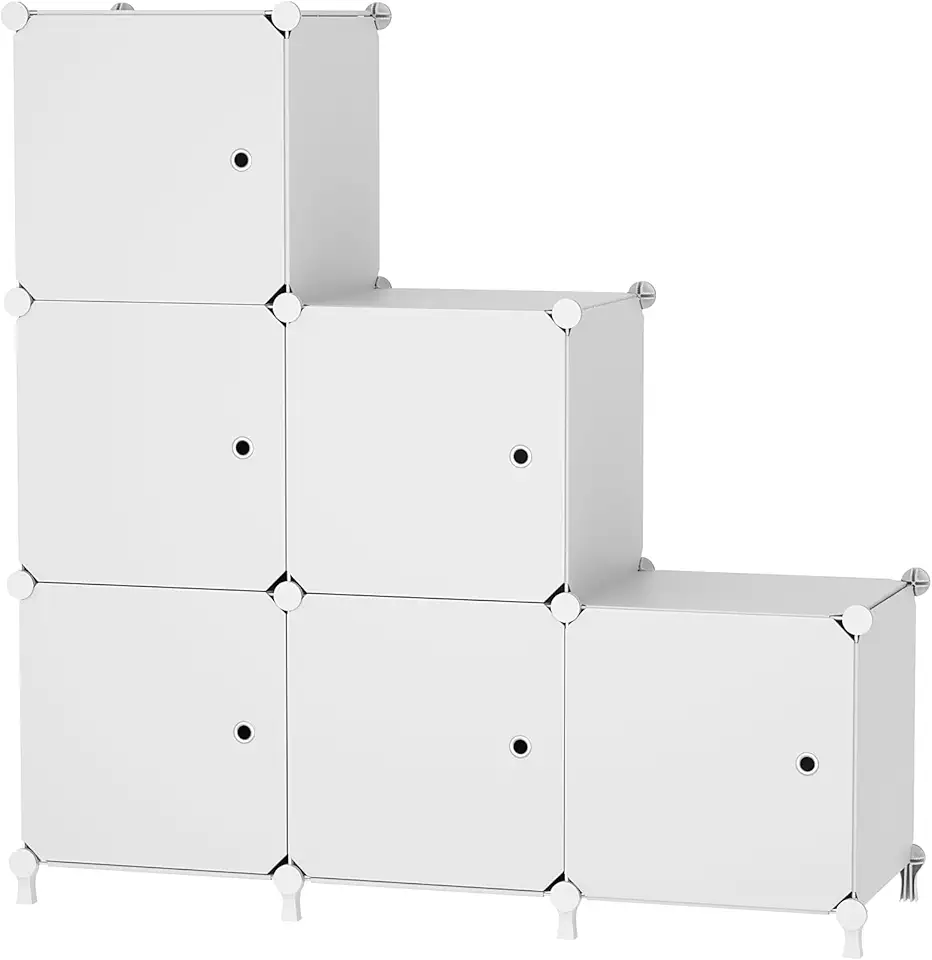
6Cube Storage Organizer Modular Stackable with Doors White
Chosen for Renter-Friendly Storage: it stacks vertically so the footprint stays fixed as capacity grows. Check the floor footprint and the walking route the unit would narrow.
VIEW AT AMAZON.COM
AWTATOS modular cube storage organizer
Matched to Renter-Friendly Storage: it replaces a pile with a defined boundary you can see at a glance. Confirm it clears the door and the stair turn on the way into the room.
VIEW AT AMAZON.COM
Spring Tension Curtain Rod 32-76 inch, White
Shortlisted for Renter-Friendly Storage: it installs with tension alone, without screws or a drill. Verify the load rating before it carries the full contents of the space.
VIEW AT AMAZON.COMKeep exploring
 Small Kitchen
Renter-Friendly Kitchen Storage: Use Fixed Cabinets Before Adding Hardware
For a rental, start with what the lease and the actual surface allow. Favor storage that can move with you, and treat adhesive, tension and over-door products as installation methods with their own limits.
SPACEKINDLY Small Kitchen
Appliances on a Small Counter: Decide What Earns a Permanent Position
For a rental, start with what the lease and the actual surface allow. Favor storage that can move with you, and treat adhesive, tension and over-door products as installation methods with their own limits.
SPACEKINDLY Apartment Storage
A Home Office in a Small Apartment: Store Work Without Taking Over the Room
A practical guide to small apartment home office with measurements, access checks and purchase conditions.
SPACEKINDLY