
Over-the-Toilet Cabinets: Check Doors, Height and Tank Access
A practical guide to above commode cabinet, focused on fit, access, measurements and buying conditions.
This page contains affiliate links. As an Amazon Associate I earn from qualifying purchases.
Measure the usable space, not the empty space for Over-the-Toilet Cabinets
Write the dimensions down while you are standing in front of the bathroom storage area, not from memory. Put width, depth and height on paper with the swing of every door and drawer and the route through the room. Keep those figures beside the listing so a remembered estimate cannot quietly replace them.
Nothing adhesive or screwed should go up on an unverified surface. Locate trim, grout, hinges and substrate changes, and establish what the agreement allows before buying. Any wall-fixed unit has to go up the way the maker describes.
Over-the-Toilet Cabinets: Plan access before adding capacity
Assign space in the bathroom storage area by how often each item is used. Put the daily set within easy reach, the weekly set a movement further, and the seldom-used wherever the gap allows. Symmetry is not the same as usability.
Assign space in the bathroom storage area by how often each item is used. Whoever or whatever needs speed gets the near position; slow-moving stock takes the far one. Even divisions look tidy and work badly.
Check moisture, cleaning and installation for Over-the-Toilet Cabinets
Moisture belongs in the specification for over-the-Toilet cabinets. Put dry things behind a door and wet things where they can drain. Confirm the instructions on materials and cleaning.
The fixing matters as much as the fitting. Identify trim, grout lines, hinges and changes in surface material, and in a rental confirm which mounting methods are permitted. Follow the maker’s method for anything that attaches to a wall.
Over-the-Toilet Cabinets: Use a simple buying checklist
Write the dimensions down while you are standing in front of the bathroom storage area, not from memory. Jot down width, depth and height beside the opening sizes, the hinge locations and the clearance you cannot give up. Store the numbers with the product page so memory does not overwrite them.
Name the failure condition before you shop. Hardware does not reduce quantity, resolve duplicates, assign owners or move items between rooms. And it fails if it covers a window, requires an absent surface, or cannot be assembled in place.
Test the layout before committing for Over-the-Toilet Cabinets
In any over-the-Toilet cabinets plan, mock up the footprint with painter’s tape, cardboard or an existing container. Perform the real routine several times: enter, reach, use, return, open nearby doors and clean around the area. This catches conflicts that dimensions alone miss. If the mock-up feels crowded, reduce depth or move the category before adding more storage hardware.
After a week, look for items that repeatedly migrate out of their assigned place. That usually means the location is inconvenient, not that the household needs stricter habits. Adjust the storage around the routine instead of forcing the routine around the storage.
Over-the-Toilet Cabinets: Kitchen-specific checks
Leave the most most-used tools near the task that needs them. Prep tools belong near the main work surface, cooking tools near the range, and cleaning supplies near the sink when the storage conditions are appropriate.
For over-the-Toilet cabinets specifically, check cabinet hinges, drawer travel and appliance doors before adding shelves or pull-outs. Extra capacity is not useful if the storage piece blocks a door from opening fully or forces one item to be removed before another can be reached.
On a small counter, protect a unblocked working zone first. An organizer earns permanent counter area only when it supports a daily task more often than the open surface would.
Sizing and fit checks for Over-the-Toilet Cabinets
Measure in this order for Over-the-Toilet Cabinets: the clear width and depth of the floor or shelf area, the height available once the unit is loaded, and the swing or pull-out clearance of every door and drawer. Add the tightest point along the route you will carry the unit through, not only the final resting position, since the narrowest gap usually decides the outcome. Recheck the smallest dimension twice, since it is the one that most often turns a promising option into a return.
DEKAVA two-tier sliding cabinet baskets, Black Paper Towel Holder, Self Adhesive Paper Towel Holder Under Cabinet and Spirich Corner Bathroom Cabinet with Doors and Adjustable Shelf, White solve that space in different ways, so compare each against your own numbers rather than against the others. Mark each constraint as required or optional before you compare, so a narrow failure on a required dimension ends the discussion instead of being argued away by a better finish. If two candidates pass everything, the tie-breaker is upkeep: choose the one you can clean without emptying it.
- wall or surface the fixings have to work with
- clear width and depth of the space
- headroom above the tallest item the unit will hold
- depth the walking route can spare
Choosing between the options for Over-the-Toilet Cabinets
The four numbers worth recording before you order anything are the external width of the space, the internal width you actually gain, the depth that can be given up without crowding the walking route, and the headroom left above the unit once it is in place. Add the distance the front of the unit sits back from the walking route once its doors are open, which is what makes a tight arrangement feel cramped. Recheck the smallest dimension twice, since it is the one that most often turns a promising option into a return.
DEKAVA two-tier sliding cabinet baskets, Black Paper Towel Holder, Self Adhesive Paper Towel Holder Under Cabinet and Spirich Corner Bathroom Cabinet with Doors and Adjustable Shelf, White all fit roughly the same envelope, which is why the checks above matter more than the product photographs. Give every candidate a pass or fail on each figure, reject anything that fails one, and only then look at colour and price. The final test is the routine rather than the specification: if putting an item back takes two extra movements, the arrangement will drift out of shape.
- tightest point on the route the unit travels to get there
- weight the shelf or bracket has to carry when full
- opening swing of every door, drawer or lid
- wall or surface the fixings have to work with
Product selection: use listings as evidence, not promises for Over-the-Toilet Cabinets
A photograph of over-the-Toilet cabinets cannot tell you what the listing can. Read the numbers: outside measurements, usable interior, which way it opens, what ships with it, and the limit the maker publishes. A picture cannot confirm a limitation.
Over-the-Toilet Cabinets: When this approach is not the right fit
The best small-bathroom setup is not the one that stores the most. It is the one that keeps everyday belongings easy to retrieve, leaves your layout functional and can be maintained without repeatedly dismantling the system.
Product candidates for Over-the-Toilet Cabinets

DEKAVA two-tier sliding cabinet baskets
Chosen for Over-the-Toilet Cabinets: it brings the back of the shelf within reach, so nothing is stored out of sight. Check the mounting surface, the weight the listing allows and the drying clearance.
VIEW AT AMAZON.COM
Black Paper Towel Holder, Self Adhesive Paper Towel Holder Under Cabinet
Matched to Over-the-Toilet Cabinets: it fixes without drilling, which matters in a rental or a tiled wall. Confirm the fixing type suits the tile or wall you have and that water can drain away.
VIEW AT AMAZON.COM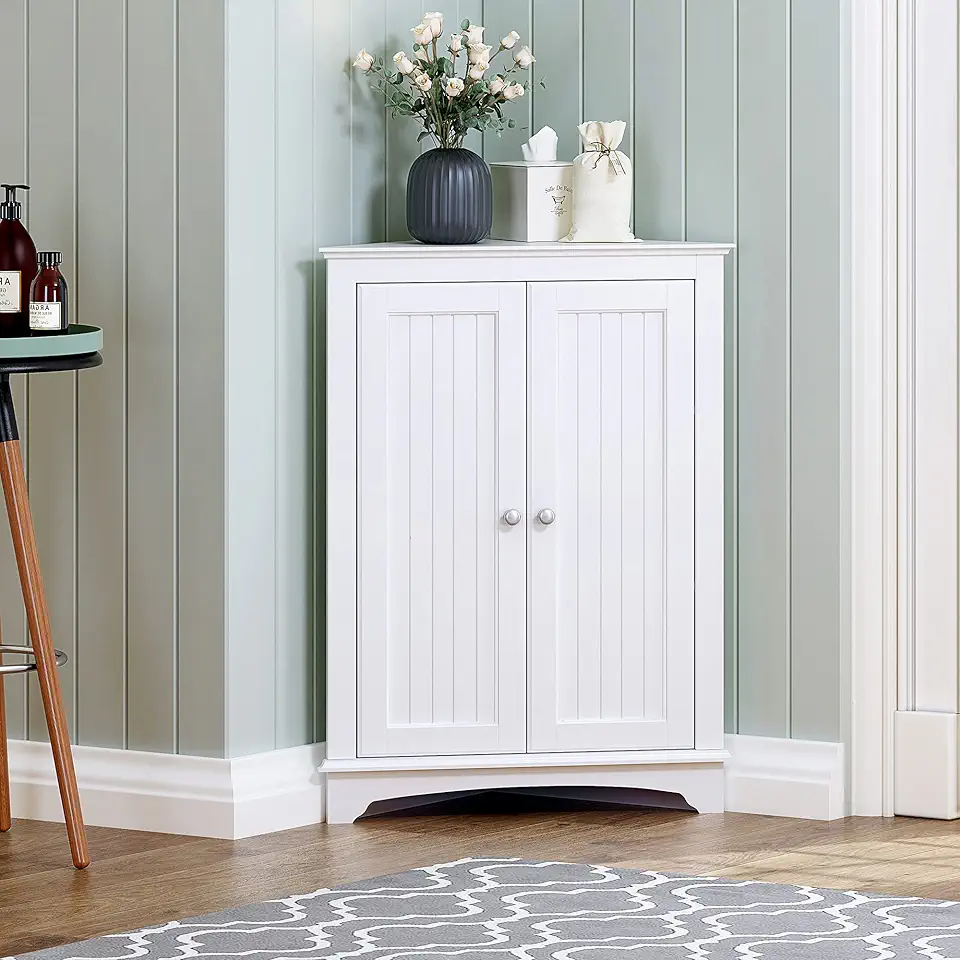
Spirich Corner Bathroom Cabinet with Doors and Adjustable Shelf, White
Shortlisted for Over-the-Toilet Cabinets: it adjusts to the width you actually measured instead of the width the room implies. Verify the internal width against the bottles and tools it has to hold.
VIEW AT AMAZON.COMKeep exploring
 Bathroom
Freestanding Bathroom Cabinets: Compare Narrow Formats, Doors and Placement
A practical guide to bathroom skinny cabinet, focused on fit, access, measurements and buying conditions.
SPACEKINDLY Closet
Small Medicine and Mirror Cabinets: Compare Fit, Doors and Shelves
A practical guide to bathroom medicine cabinet small, focused on fit, access, measurements and buying conditions.
SPACEKINDLY Small Kitchen
How to Organize Kitchen Cabinets by Zone and Shelf Height
Arrange kitchen cabinets around preparation, cooking, serving and cleaning, using safe retrieval and the actual room layout to choose each category’s home.
SPACEKINDLY